We Create Marketing Strategies
For Small Waste Management Companies
And Junk Removals
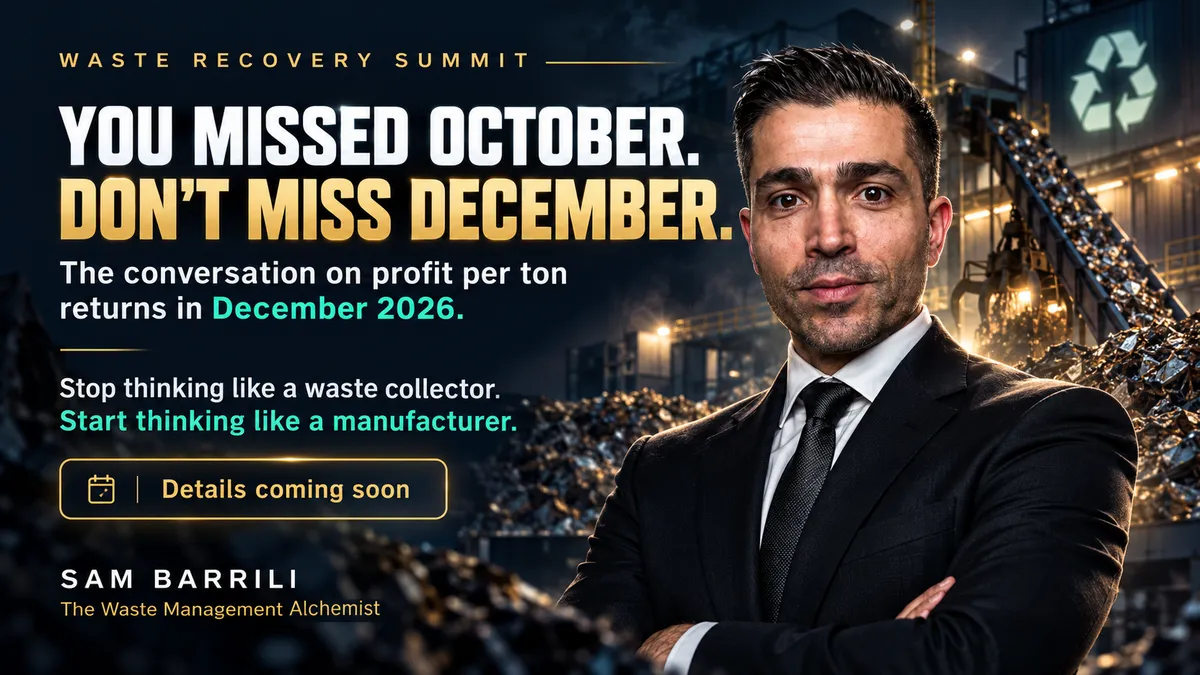
What the Waste Industry Missed on October 14 — And Why It’s Coming Back in December
We stopped talking about how many tons waste companies collect and started asking how much money they actually keep. That conversation isn’t finished.
Your waste company may be making more money than ever. And still losing money on every ton.
Revenue is up. The fleet is bigger. Tonnage keeps climbing. And yet margins feel tighter every year.
If that sounds familiar, the problem may not be your sales team or your fuel bill. It may be a number most owners never calculate:
How much profit do you actually make per ton?
On October 14, at the Waste Recovery Summit, that was the question on the table. We stopped talking about how much waste companies collect. And started talking about how much money they actually keep.
What You Missed in October
These are the ideas that should make any owner look at their own operation differently.
More tons don’t automatically mean more profit. Tonnage tells you how busy you are. It doesn’t tell you whether you’re making money. A stream that loses money on every ton doesn’t fix itself with volume. It just loses faster.
Value leaks out in five places: collection, contamination, processing, material sales and disposal. Rarely all at once. Usually a little at each stage, quietly enough that nobody flags it.
Controlling collection isn’t controlling value. If you move the material but don’t understand its downstream markets, someone else captures the margin. Your trucks do the hard work. Another operator keeps the upside.
Recovery percentage is not profitability. A high recovery rate looks good on paper. But physics, material quality and processing costs decide whether recovery makes money or burns it.
And maybe the most uncomfortable point of the day: for many operators, the most profitable first investment isn’t another shredder. It’s better contracts and better buyer relationships.
Same Company. Same Materials. Different Strategy.
I learned this long before I had a name for it.
Years ago, I was at a company that manufactured water treatment systems. Returned industrial materials were costing more than $1 million a year in transport, handling and disposal.
On paper, it was waste. Looking at it as a chemist, I saw copper, aluminum, electronics, silver and membranes. Materials with a market.
We reorganized the recovery process and partnered with specialized operators who knew what to do with each fraction. In under three months, that division went from draining cash to generating positive cash flow.
Not all of that $1 million became profit. That isn’t the point. The point is that the same materials, inside the same company, produced a completely different financial result once someone treated them as assets instead of liabilities.
That experience is one of the foundations of what became the SAM Method — Stream Advanced Management.
It also raises a question every owner should ask: what is moving through your operation right now that you’re paying to get rid of?
The Number Worth Running for Yourself
Here’s the hypothetical example from the October presentation. It is an illustration, not a result achieved by any Summit participant.
A company processes 10,000 tons a year and improves contribution by $25 per ton. That’s $250,000 in additional annual contribution before implementation costs. Assume $50,000 to implement, and the first-year improvement is $200,000.
No new trucks. No new territory.
So what if your company doesn’t need another truck to increase profits? What if it needs a better understanding of the material already moving through its operation?
Where would that $25 come from in your business? Which stream? Which contract? Which buyer?
Those are questions most operators have never been asked.
October Was One Conversation
But this subject is far too important to leave there.
THE WASTE RECOVERY SUMMIT IS RETURNING IN DECEMBER 2026.
Here’s why I’m bringing it back.
For more than 15 years, I’ve watched operators spend serious money on equipment, trucks and expansion while overlooking the economics of the streams they already control. Good businesses. Smart owners. Making decisions on tonnage and revenue because nobody gave them a more precise way to measure value.
I believe waste companies deserve a more rigorous way to understand how value is created, and where it’s captured or lost.
That’s the conversation I want to continue.
The Question That Stays Open
If you knew exactly which material stream was producing your best margins — and which one was quietly consuming them — would you run your company differently?
In my experience, very few owners can say which streams are which.
December is another opportunity to work through the ideas behind the SAM Method and the economics of material recovery. It won’t solve every problem in your business. But it may change the questions you ask about it.
Don’t Miss the Announcement
The December Waste Recovery Summit is coming. The date and registration details will be announced soon. Keep an eye on my updates — because if you missed October, this is your opportunity to join the conversation.
Follow me on LinkedIn or subscribe to the Trash To Cash newsletter so you see the announcement when registration opens.
And if you run a waste management company and don’t want to wait until December to look at your own material economics, you can request a private 20-minute Profit Qualification Call: https://sambarrili.com/schedule-free-20min-call
Stop counting tons. Start counting what you keep.
To Your Success
Sam Barrili
The Waste Management Alchemist

As Seen In

Do You Struggle With This?
Would you like to generate more customers systematically but don't know how?
Do you want to optimize cost efficiency and improve your company's profitability?
Do you want to win customers' skepticism and avoid negative perceptions about your services?
Do you want to enhance your brand visibility to attract new and highly profiled clients?
Do you want to increase your company's turnover but don’t want to hire more people?
Do you want to stay ahead of your competitors, but you cannot fight the price battle?
Why People Work With Us
Waste Management Experience
More More than 15 years of direct expertise managing hazardous waste all around the world.
Global Expertise
Our strategies are successful in the collection of recyclables, MSW, and hazardous waste.
A Tailored Service
Our direct-response marketing is tailored to help Small Waste Companies and Junk Removals.
M4W - Marketing For Waste is a brand of MiM LLC - 16192 Coastal Highway - 19958 Lewes - DE - USA
[email protected]