We Create Marketing Strategies
For Small Waste Management Companies
And Junk Removals
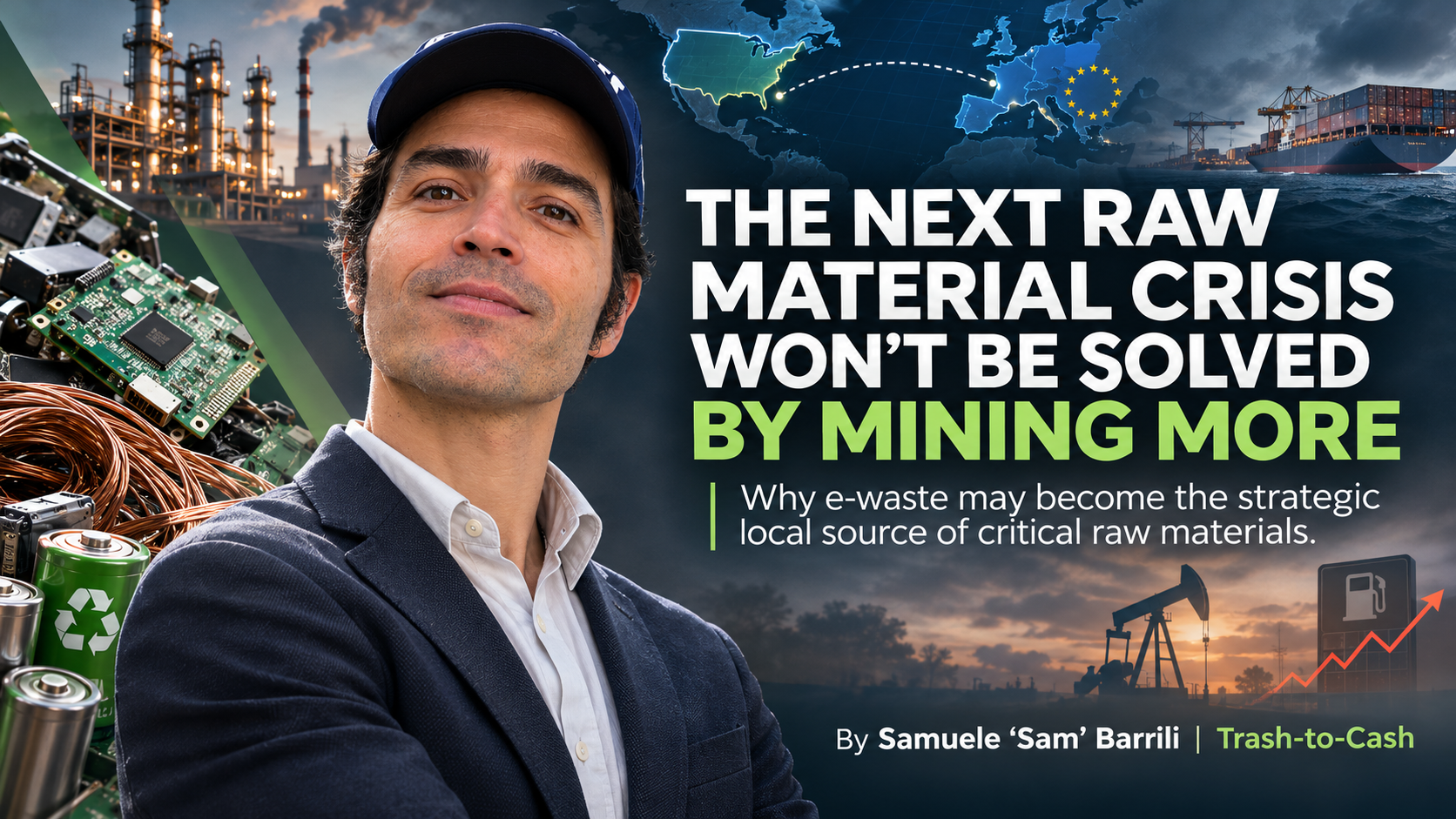
The Next Raw Material Crisis Won't Be Solved by Mining More
How war, fuel costs, and broken supply chains are turning electronic waste into a strategic industrial resource.
On November 27, 2026, a deadline expires that most manufacturers have never heard of.
In November 2025, China suspended its outright ban on exporting gallium, germanium, and antimony to the United States. The suspension runs until November 27. As of mid-November, no public notice extending it had been reported (InvestorNews).
Three metals. One date. One government's decision.
That is the whole problem in miniature. And the answer to it is not only in the ground. A meaningful part of it is sitting in our warehouses, our transfer stations, and our scrap bins.
Part I — The Imported Raw Materials Trap
Picture a manufacturer in Ohio or Emilia-Romagna. A full order book. Trained crews. Machines with spare capacity. Customers waiting.
The plant still misses its delivery dates.
A power module needs a gallium-based chip. A servo motor needs a rare earth magnet. An aluminum order arrives weeks late and far above the price on the quote. Nobody in the building did anything wrong.
The problem is not demand. The problem is the supply chain.
For thirty years, Western industry optimized for one variable: the lowest delivered cost. That built supply chains that were commercially competitive. It did not build supply chains that were resilient.
The difference matters. A competitive chain wins on price when everything works. A resilient chain keeps delivering when something breaks. In a normal year, you cannot see the difference. In a bad year, it is the only thing that matters.
Every imported material carries dependencies that never appear on the purchase order. The energy that mined and refined it. The bunker fuel that moved it. The insurer who covered the ship. The handful of refineries that processed it. The ministry that licensed its export.
So here is the question most procurement teams avoided until recently:
What happens when your production depends on resources controlled, or processed, thousands of miles away?
Since 2022, we have been getting the answer in installments.
Part II — How the Ukraine War Changed Industrial Security
Russia invaded Ukraine on February 24, 2022. For European industry, the first shock was not minerals. It was energy.
The Dutch TTF gas benchmark peaked at about €340 per MWh in August 2022 (bne IntelliNews). Energy-intensive metal producers could not run at those prices. Two aluminum smelters tell the story. Slovalco in Slovakia and New Madrid in Missouri were fully idled for years, hit by low metal prices and the post-invasion energy spike. Both are only now restarting, in 2026 (Reuters via Engineering News).
That is lesson one. Every tonne of metal contains its energy bill. When energy breaks, the materials made with it break too.
Lesson two concerns Ukraine itself. According to Ukrainian economy ministry data, the country holds deposits of 22 of the 34 minerals the EU classifies as critical (Reuters factbox via AJOT). It produces titanium today and holds large graphite reserves.
But geology is not supply. Ukraine's graphite production was about 0.5% of global output in 2020 (NPR). Lithium mining has not started. Two of the largest lithium deposits are in Donetsk and Zaporizhzhia. Much of the Soviet-era survey data needs re-verification before anyone can bank a project on it.
The US–Ukraine minerals agreement signed in April 2025 may unlock projects over time. It will not put Ukrainian lithium into a European cathode plant this year, or next.
Ukraine can be a credible long-term contributor for Europe. It is not the supplier of all the critical raw materials Europe needs. What the war really exposed was how long, how thin, and how concentrated our industrial supply chains had become.
Part III — The 2026 Iran War: The Hidden Cost of Moving Materials
On February 28, 2026, US and Israeli strikes on Iran started a war that is still unresolved almost nine months later. Iran effectively closed the Strait of Hormuz, which carried about a fifth of the world's oil and LNG before the war.
Separate what the war cut off from what it made more expensive. Most manufacturers felt the second, not the first.
Direct interruptions. QatarEnergy halted LNG production on March 2, and Iranian strikes on Ras Laffan later took about 17% of Qatar's export capacity offline (GIS). European gas jumped from €31.95 per MWh on February 27 to about €55 within days. Gulf aluminum, about 8% of world primary capacity, lost Emirates Global Aluminium's Al Taweelah smelter to missile damage; full output is not expected until the first quarter of 2027 (AlCircle). That matters in America: the US relies on imports for 60% of its aluminum.
Indirect cost increases. Before the war, war-risk insurance through Hormuz cost about 0.25% of a ship's hull value. By July, a $100 million tanker faced a premium of $3 million to $10 million (The National). Freightos data showed container rates from Shanghai to Jebel Ali rising from about $1,800 in January to over $7,000 by late March (ITLN).
Then came the cost almost nobody modeled: sulfur. The Middle East produces about 24% of the world's sulfur, as a by-product of oil and gas refining (Reuters via Kitco). Sulfuric acid leaches copper, nickel, cobalt, and lithium. Benchmark Mineral Intelligence reported sulfur prices up more than 50% since the war began, with acid prices doubling in some regions. In Indonesian high-pressure acid leach nickel, sulfur rose from 26% to 42% of production costs (MINING.com).
Read that again as a chemist would. Nickel from Indonesia and copper from Congo have nothing to do with Iran. Their cost still rose, because a reagent derived from Gulf hydrocarbons did.
Now the honest part. The war did not make critical minerals unavailable. Brent traded around $92 on November 19, against roughly $72 before the war (CNBC), and Reuters reports crude shipments through Hormuz close to pre-war levels. LME aluminum is back near $3,000.
But the exchange price is not the delivered price. On October 12, European buyers paid about $3,614 per tonne all-in for aluminum, against an LME cash price of $3,055 (Crux Investor). That gap is freight, premium, and risk. It is what the war added to the invoice.
And the strait is still contested. On November 7, only five commodity vessels crossed it; on November 8, Kpler recorded none (Al Jazeera).
You cannot hedge a chokepoint with a futures contract.
Part IV — The Critical Raw Materials Problem Is Bigger Than War
Wars accelerate vulnerabilities. They rarely create them.
The real choke point is not where a mineral is mined. It is where it is processed. The IEA's Global Critical Minerals Outlook 2026, published in July, found that over three-quarters of refined supply growth in the past two years came from a single dominant supplier: Indonesia for nickel, China for the other key energy minerals. In graphite, manganese, and nickel, virtually all growth came from that one supplier. China's share of rare earth refining eased only from over 90% in 2023 to 85% in 2025. Meanwhile, critical mineral investment fell 9% in 2025 (IEA).
Concentration becomes leverage through export licensing. China's April 2025 rare earth controls forced some automakers to cut or briefly halt production. The IEA estimates that its expanded October 2025 measures, if fully enacted, could jeopardize about $6.5 trillion of annual downstream production outside China. Those expanded measures are now paused until January 10, 2027 (MLQ). The licensing regime for gallium and germanium, in place since August 2023, never paused at all.
The exposure is measurable on both sides of the Atlantic:
United States. The USGS Mineral Commodity Summaries 2026 reports the US was 100% net import reliant for 13 minerals on its critical list in 2025, and more than 50% reliant for 20 more (NMA summary of USGS).
European Union. The EU sources about 98% of its rare earth magnets from China (Euronews). Eurostat shows that in 2025, China supplied 46.8% of EU rare earth element imports by weight, Russia 25.9%, and Malaysia 23.1% (Brussels Times).
Precision matters here. "Critical" is a legal classification, and the lists differ. Gallium, germanium, cobalt, lithium, natural graphite, and rare earths sit on both the EU and US lists. Aluminum is on the US list. The EU added copper and nickel to its Critical Raw Materials Act as strategic materials even though they do not meet its usual criticality thresholds. Gold and silver are economically important to any e-waste business, but they are not why governments are worried.
What these materials do is not abstract. Gallium goes into power electronics and RF chips. Germanium goes into fiber optics and infrared optics. Rare earth magnets drive motors, robots, wind turbines, and guidance systems. Cobalt, lithium, nickel, and graphite go into batteries. Copper goes into everything that carries a current.
That list is also an inventory of what we throw away.
Part V — The Resource That Europe and America Already Own
The most reliable new source of strategic metals in the West does not need a mining permit. It needs a forklift, a trained dismantler, and a buyer with a specification.
The Global E-waste Monitor 2024, published by ITU and UNITAR, reports on the year 2022. That year, the world generated a record 62 million tonnes of e-waste. Only 22.3% was documented as formally collected and recycled. Those 62 million tonnes contained 31 million tonnes of metals worth about $91 billion, including $19 billion of copper, $15 billion of gold, and $16 billion of iron. Formal recycling recovered about $28 billion of secondary raw materials. Generation is on track to reach 82 million tonnes by 2030 (UNITAR).
Europe leads, with 42.8% documented collection and recycling. Even so, Eurostat shows the EU collected 11.6 kg of e-waste per inhabitant in 2023, while 32.2 kg of new equipment per person was placed on the market (Eurostat via EU Transition Pathways). Equipment lasts years, so those numbers are not a like-for-like loss. They do show how much material is accumulating in homes, offices, and plants, waiting to be discarded.
What is inside, stream by stream:
Copper in wiring, motors, compressors, transformers, and circuit boards.
Aluminum in frames, housings, heat sinks, and structures.
Gold, silver, and palladium in connectors, contacts, and printed circuit boards.
Rare earth elements in the permanent magnets of hard drives, motors, and speakers.
Cobalt, lithium, and nickel in specific battery chemistries.
Gallium, germanium, tantalum, and indium in specialized components, usually at trace concentrations.
Not every device holds commercially recoverable quantities of every metal. As a chemist, I separate three numbers that the market routinely confuses:
Theoretical content: what the bill of materials says is in the device.
Technically recoverable content: what existing processes can extract.
Economically recoverable content: what can be extracted at a cost below what a buyer will pay.
The gap between the first and third numbers is where most e-waste business plans die. A neodymium magnet inside a hard drive is real. Once the drive goes through a shredder, that magnet is fragmented, magnetized onto steel, and lost to the ferrous fraction. Gallium in an LED is real too. At trace concentrations, it is rarely worth chasing.
This is what urban mining means as a business model. Not a slogan about recycling, but an ore body with a known location, a measurable grade, and, often, a customer who is already paying you to take it away.
Part VI — Why E-Waste Collectors Could Become Industrial Suppliers
Most e-waste operators run one revenue line: they charge to collect, then sell mixed material to whoever pays the most that week. The opportunity is a second revenue line built on material sold to specification.
The value chain has eight steps:

E-waste value chain · 8 steps, 3 owners
Only the two middle steps need industrial-scale metallurgy. Everything before them happens on your floor; everything after them is a contract.
A small or mid-sized operator does not need to own all eight. It needs to own the steps where value is created or destroyed, and control the relationships at the end.
The first four steps belong to you. Collection, identification, selective dismantling, and mechanical separation require labor, training, floor space, and discipline. They do not require a smelter. They are also where most value is lost: one careless shred can turn a sorted, assayable fraction into low-grade mixed scrap.
Specialized treatment and refining usually belong to partners. Recovering precious metals from circuit boards takes an integrated smelter. Europe has a handful, such as Umicore's Hoboken plant, Aurubis, and Boliden's Rönnskär. Battery black mass goes to hydrometallurgical refiners. Magnet recycling is still an emerging industry.
The commercial layer belongs to whoever controls the specification. Certification and industrial sales are not physical steps. They are relationships, data, and contracts. A collector that delivers consistent, documented lots can sell on assay, negotiate treatment and refining terms, or have material toll-processed and keep title through to the refined metal.
Four realistic plays for operators without refining assets:
Board grading. Stop selling "mixed boards." Separate high-grade server and telecom boards from low-grade consumer boards. Smelters pay on assay, so grade separation moves material into a different price bracket.
Motors, compressors, and cable. Pull them before shredding. Clean copper-bearing fractions sell to a published specification. Shredded mixes sell at a discount and carry contamination deductions.
Battery pre-sorting. Remove lithium-ion packs before mechanical processing. It cuts fire risk on your floor and creates a separate stream for licensed battery recyclers.
Magnet harvesting. Recover magnets from hard drives and industrial motors and aggregate them for magnet recyclers, before they disappear into the ferrous fraction.
What makes these plays work is not equipment. It is knowledge of material composition, identification of high-value components, contamination control, traceability and chain-of-custody documentation, written material specifications, consistent supply, full regulatory compliance, and, eventually, long-term offtake contracts.
Margin follows quality. Buyers pay for what they can assay and deduct for what they have to clean. A fraction that meets specification every time is worth more than a slightly bigger fraction that meets it half the time. Reliability is a product.
Part VII — A Local Resource Isn't Automatically a Local Supply
Here is the uncomfortable truth. Recovering copper or circuit boards in Ohio or Lombardy does not mean they will be refined or reused there.
Material goes where the downstream capacity and the best price are. EU aluminum scrap exports hit a record 1.27 million tonnes in 2025, about 50% above 2019 (BigMint). Primary producers call it "scrap leakage" and want export curbs. Recyclers answer that high exports reflect weak domestic demand and too little EU processing capacity (Fastmarkets). The Commission promised a measure for spring 2026, delayed it, and now appears to be moving toward a restriction under the Waste Shipments Regulation instead of an export duty.
Both sides are describing the same fact. A secondary raw material stays local only when a local buyer can process it and wants it.
Brussels has noticed. The RESourceEU Action Plan, adopted on December 3, 2025, targets about €3 billion for priority projects in 2026 and includes measures to keep scrap and end-of-life products, starting with permanent magnets, inside the EU (Chambers). The second list of Critical Raw Materials Act strategic projects includes recycling plants for copper and platinum group metals (EU factsheet).
That helps. It does not erase the hard limits:
Dispersion. Critical metals in electronics are often present at trace levels, spread across thousands of components. Chemistry can recover them. Economics often cannot.
Scale. A refinery needs steady tonnage. Fragmented collection rarely delivers it.
Demand growth. The IEA expects critical mineral demand to almost double by 2040 in its Stated Policies Scenario (IEA). Recycling today's discards cannot cover tomorrow's demand.
The EU's own 2030 benchmark is that recycling capacity should cover 25% of its strategic raw material consumption (EUobserver). A quarter, not all of it.
So let me be explicit. Secondary raw materials will not replace mining or international sourcing. The objective is narrower and more achievable: reduce avoidable dependency by building credible, supplementary domestic supply.
Part VIII — What the Market Should Measure
If you measure tonnes, you will manage tonnes. If you measure recovered value, you will build a resource business. Here is the scorecard I would put in front of any e-waste operator, and any industrial buyer evaluating one.

These metrics matter to four audiences. Management uses them to see which streams make money. Finance uses them to stop subsidizing loss-making streams with profitable ones. Industrial procurement uses them to judge whether a supplier is reliable. And buyers of waste businesses can use them in due diligence, because recurring, contracted, specification-grade revenue is easier to underwrite than spot scrap sales.
To be clear: there is no single, universally adopted recovery-based valuation method today. But an operator that can document rows 4 through 10 is telling a very different story from one that can only report row 1.
Part IX — The Opportunity for Waste Management Entrepreneurs
You do not need to understand the Strait of Hormuz to act on this. You need a stream, a spreadsheet, and a buyer. Here is the sequence I recommend, in order.
Pick one stream. Not "e-waste." One stream you already receive in volume: commercial IT, telecom equipment, cooling appliances, industrial motors and drives. Focus beats breadth.
Analyze its composition. Sample real lots. Weigh what comes out by fraction. Get assays on boards and mixed metal fractions. Replace assumptions with your own numbers.
Map processors and buyers. List the smelters, refiners, and specialized recyclers that accept each fraction. Get their specifications, payment terms, treatment charges, minimum lot sizes, and penalty schedules in writing.
Model costs against revenues. Labor per tonne for dismantling, storage, freight, compliance, and treatment charges on one side. Payable metal value on the other. If the stream does not earn a positive contribution margin on paper, it will not earn one on your floor.
Run a controlled program. Start a segregation or selective dismantling line for that one stream. Train the crew. Document every step. Measure yield and contamination by lot.
Contract downstream. Move from spot sales to framework agreements, then to offtake contracts once volumes and quality are proven.
Track what actually happens. Quality, margin per stream, and the real destination of every lot. If you cannot say where your copper went, you cannot sell traceability.
Scale only when the model repeats. Repeatable means consistent specification, consistent margin, and a buyer who wants more. Then add the second stream.
The operators who win this decade will not be the ones with the biggest trucks. They will be the ones who know, to the gram, what is in their yard and who will pay for it.
Part X — Why This Is the Real Problem With Zero Waste
Now connect the dots.
The wars revealed the problem. Fuel and freight revealed the financial exposure. Concentrated refining and export controls revealed the industrial risk. Electronic waste revealed an underused domestic resource. Material recovery revealed a commercial path.
And almost none of it shows up in a Zero Waste target.
Zero Waste, Net Zero, recycling, and material reintegration are four different things. A landfill diversion rate tells you where waste did not go. It does not tell you where the metal went. A collection target tells you how many tonnes entered a facility. It does not tell you whether a single kilogram of gallium, cobalt, or copper came back into a factory. You can hit every diversion target in the book and still export your strategic metals as low-grade scrap, or lose them in a shredder's fines.
There is also a law of physics in the way. Every recovery step consumes energy, and every product disperses its materials a little further. Perfect circularity is not a policy choice. It is thermodynamically out of reach. The rational goal is not "zero." It is the efficient recovery and reintegration of the resources that are worth bringing back, measured by what actually returns to production.
Which leads to the statement I want every policymaker, investor, and operator to sit with:
"A country that collects its waste but cannot recover and reuse its strategic materials has not solved its resource dependency problem."
The Next Crisis Starts Somewhere Else
The next industrial crisis may not begin in a factory.
It may begin thousands of miles away, with a disrupted shipping lane, an energy shock, or a licensing decision on a critical metal.
And yet, every day, we keep discarding electronic equipment containing the materials our industries need.
The problem isn't simply how much waste we generate. It's how little of its recoverable value we bring back into production.
That's why I wrote The Zero Waste Lie: Why the Laws of Physics — Not Marketing Hype — Should Run Your Waste Business.
In it, I challenge the assumptions behind conventional Zero Waste thinking. I use the hard rules of chemistry and thermodynamics, conservation of mass, entropy, and the energy cost of recovery, to show why waste must be managed as a question of natural resources, industrial value, and economic opportunity.
If you own a waste management company, invest in the industry, work in manufacturing, or want to understand where the next strategic opportunities will come from, this is the framework that separates slogans from margins.
[Get your copy of The Zero Waste Lie on Amazon today → https://shorturl.at/KwH7j]
To Your Success
Sam
Sam Barrili has worked in waste management since 2009. He is the author of The Waste Alchemy and The Zero Waste Lie*, and writes the* Trash-to-Cash newsletter.
Sources
Data current to November 19, 2026.
IEA, Global Critical Minerals Outlook 2026 — press release and Outlook chapter (July 2026)
USGS, Mineral Commodity Summaries 2026 (February 2026), via NMA summary
ITU / UNITAR, Global E-waste Monitor 2024 (2022 data)
Eurostat, WEEE statistics (2023 data); EU rare earth imports 2025 via Brussels Times
European Commission, RESourceEU Action Plan, via Chambers and IEA policy database; CRMA Strategic Projects factsheet; CRMA benchmarks via EUobserver
China export controls: InvestorNews, MLQ, Engineering News / Reuters
Energy and shipping: CNBC, Nov. 19, 2026; Forbes, Nov. 19, 2026; Al Jazeera, Nov. 12, 2026; The National; ITLN / Freightos; GIS; Anadolu; bne IntelliNews
Metals: Reuters via ARY; Kpler; AlCircle; Crux Investor; Reuters via Engineering News; MINING.com / Benchmark; Reuters via Kitco
Scrap trade: BigMint; Fastmarkets
Ukraine: NPR; Reuters factbox via AJOT; GIS
EU dependency on China: Euronews

As Seen In


Do You Struggle With This?
Would you like to generate more customers systematically but don't know how?
Do you want to optimize cost efficiency and improve your company's profitability?
Do you want to win customers' skepticism and avoid negative perceptions about your services?
Do you want to enhance your brand visibility to attract new and highly profiled clients?
Do you want to increase your company's turnover but don’t want to hire more people?
Do you want to stay ahead of your competitors, but you cannot fight the price battle?
Why People Work With Us
Waste Management Experience
More More than 15 years of direct expertise managing hazardous waste all around the world.
Global Expertise
Our strategies are successful in the collection of recyclables, MSW, and hazardous waste.
A Tailored Service
Our direct-response marketing is tailored to help Small Waste Companies and Junk Removals.
M4W - Marketing For Waste is a brand of MiM LLC - 16192 Coastal Highway - 19958 Lewes - DE - USA
[email protected]