We Create Marketing Strategies
For Small Waste Management Companies
And Junk Removals
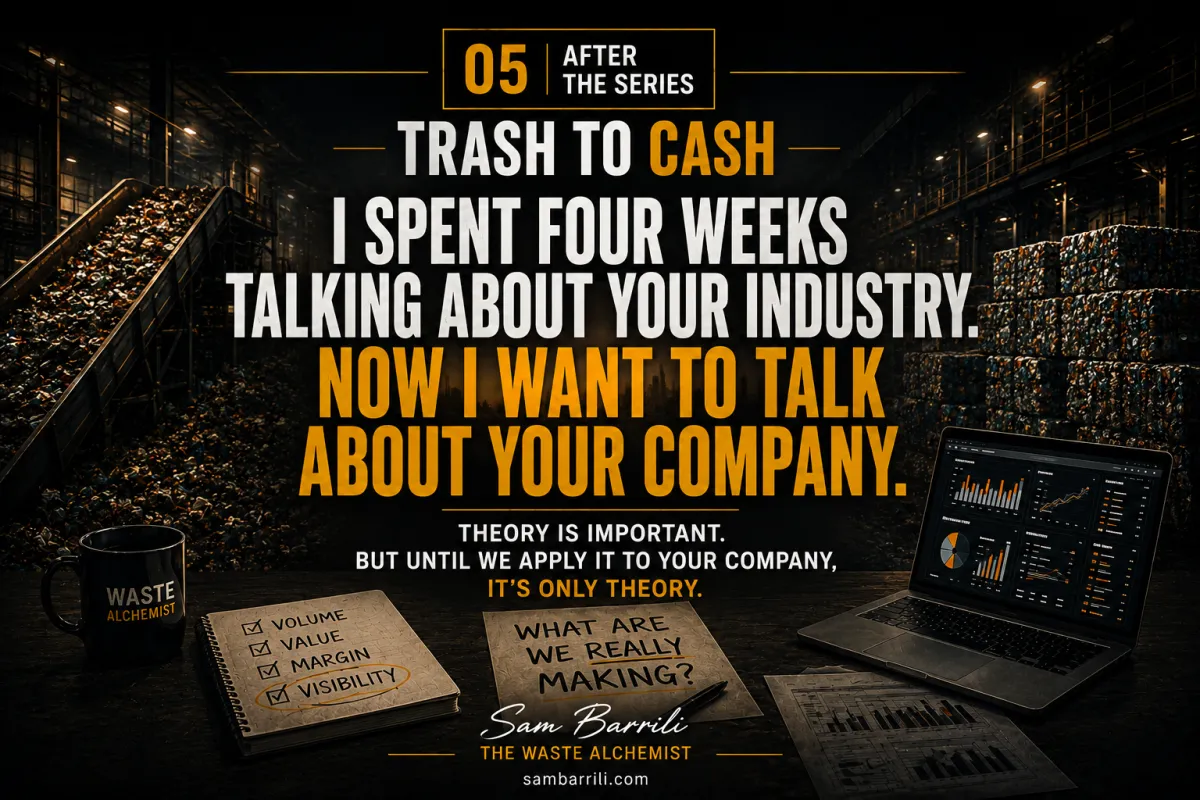
I Spent Four Weeks Talking About Your Industry. Now I Want to Talk About Your Company
For the last four weeks, I've asked waste company owners to look at their businesses through something other than trucks.
Not routes.
Not tons.
Value.
And judging by the replies, the argument landed.
But there's a problem with everything I've written so far. Until you apply it to your own company, it's theory. Mine, not yours.
So today I'm not handing you another article.
I'm handing you four questions.
Answer them honestly and you'll know more about your own profitability than most owners learn in a year. Or you'll find there are things about your own business you currently can't answer. Both outcomes are useful.
Quick reminder of where we've been, because these four questions sit on top of it.
The Per-Ton Ceiling: growth by volume eventually stops producing proportional profit.
The competitor you don't watch: the company downstream may earn more from your material than you do.
The manufacturing business you're running like a hauling company: you control the movement of material and the fate of material. Two different businesses.
And the last one: the next million rarely arrives on another truck. It comes from seeing the company you already own more clearly.
That's the theory. Here's the test.
Question 1. What are your three most profitable material streams?
Not highest revenue. Not highest tonnage. Not the biggest gate fee.
Highest net economic contribution. What's actually left after everything it costs you to collect it, handle it, process it, move it, and place it downstream.
Name three. In order.
Most owners can rank their biggest streams by weight in two seconds. Ask them to rank the same streams by profit and the room goes quiet.
Question 2. Which three streams quietly destroy value?
Every operation has them. Streams that look like revenue on the invoice and turn into losses once you count collection, handling, contamination, processing, transport, and where they finally end up.
Not the streams you dislike. The ones costing you money you've never isolated.
If you can't name three, it isn't because you don't have them. It's because nobody has ever separated them out.
Question 3. When did you last benchmark the downstream market for your major streams?
I don't mean the day your buyer changed your price.
I mean the last time you deliberately went looking. Different buyers. Different specifications. Different applications. Different processing routes. A different commercial structure entirely.
If the honest answer is "my buyer sets the price and I take it," you already have your answer.
Question 4. Who inside your company is responsible for material profitability?
Not operational efficiency. Not route density. Not commodity sales.
The profitability of the material itself.
Someone owns safety. Someone owns the fleet. Someone owns collections.
Who owns the number that says each stream is earning what it could?
If the answer is "nobody," that isn't a criticism. It's the most common answer I get. But it tells you something.
Here's how to read your own answers.
If you answered all four quickly, with numbers behind them, good. You may not need anything from me. Genuinely. Some operators have this wired, and I'd rather you keep your time than book a call to tell me what you already know.
If you couldn't answer one or more, resist the obvious conclusion.
The obvious conclusion is: "there's money sitting there."
That's the exact mistake I don't want you to make.
An unanswered question doesn't mean there's opportunity. It means there's something you don't know yet. Those are not the same thing.
Before you change processors, buy equipment, or rebuild a process, the intelligent first move is cheaper and far less dramatic:
Find out whether the opportunity is actually real.
That's what the 20-Minute Profit Qualification Call is for.
Let me be precise about what it is and isn't, because I've watched how these things get read.
It is not a free consulting session. It is not a strategy session. It is not a diagnostic. It is not a sales call wearing a consultant's jacket.
It's a qualification conversation. It answers one question and nothing more:
Is there enough evidence inside your operation to justify a deeper profitability analysis?
On the call, I'll look at a handful of things. Your primary streams. Rough volumes. Where the material currently goes. How you monetize or dispose of it now. And the obvious gaps where commercial information is simply missing.
I won't promise to find money. I won't promise savings. I won't promise a revenue number. Anyone who does that before seeing your operation is selling, not advising.
There are three ways the call can end.
One: there's enough evidence to justify a deeper look. The next step would be the Waste Stream Profit Diagnostic.
Two: there might be something there, but your business isn't ready for a full diagnostic yet. I'll tell you what to do in the meantime, and none of it requires paying me.
Three: there isn't enough to justify further work. I'll say so plainly. No manufactured opportunity. No pressure.
That third outcome is real. I'd rather end a call there than talk you into something that doesn't pay for itself.
The Diagnostic is the paid, deeper engagement. It only makes sense if the call says it does. I'm not going to sell you the second step before we've done the first.
I run these calls myself, so I can only take a limited number each week. If the timing matters to you, apply sooner rather than later.
If you followed this series and couldn't confidently answer one or more of those four questions, this is the logical next step.
Don't buy equipment. Don't switch vendors. Don't assume there's opportunity.
Find out whether there's anything worth investigating.
[APPLY FOR THE 20-MINUTE PROFIT QUALIFICATION CALL]
Four weeks ago, this started with the economics of collecting one more ton.
It ends somewhere else entirely. Not with tonnage. With visibility.
The material is already moving through your business. The trucks are already running. The customers already exist. Every one of those streams crosses your scale, every day, whether or not anyone has asked what it's actually worth.
The next opportunity in your business may not require another truck.
It may just require finally seeing the company you already own.
Before you go looking for your next million outside the gate, make sure you know what's already crossing the scale.
To Your Success
Sam
The Waste Management Alchemist


As Seen In

Do You Struggle With This?
Would you like to generate more customers systematically but don't know how?
Do you want to optimize cost efficiency and improve your company's profitability?
Do you want to win customers' skepticism and avoid negative perceptions about your services?
Do you want to enhance your brand visibility to attract new and highly profiled clients?
Do you want to increase your company's turnover but don’t want to hire more people?
Do you want to stay ahead of your competitors, but you cannot fight the price battle?
Why People Work With Us
Waste Management Experience
More More than 15 years of direct expertise managing hazardous waste all around the world.
Global Expertise
Our strategies are successful in the collection of recyclables, MSW, and hazardous waste.
A Tailored Service
Our direct-response marketing is tailored to help Small Waste Companies and Junk Removals.
M4W - Marketing For Waste is a brand of MiM LLC - 16192 Coastal Highway - 19958 Lewes - DE - USA
[email protected]