We Create Marketing Strategies
For Small Waste Management Companies
And Junk Removals
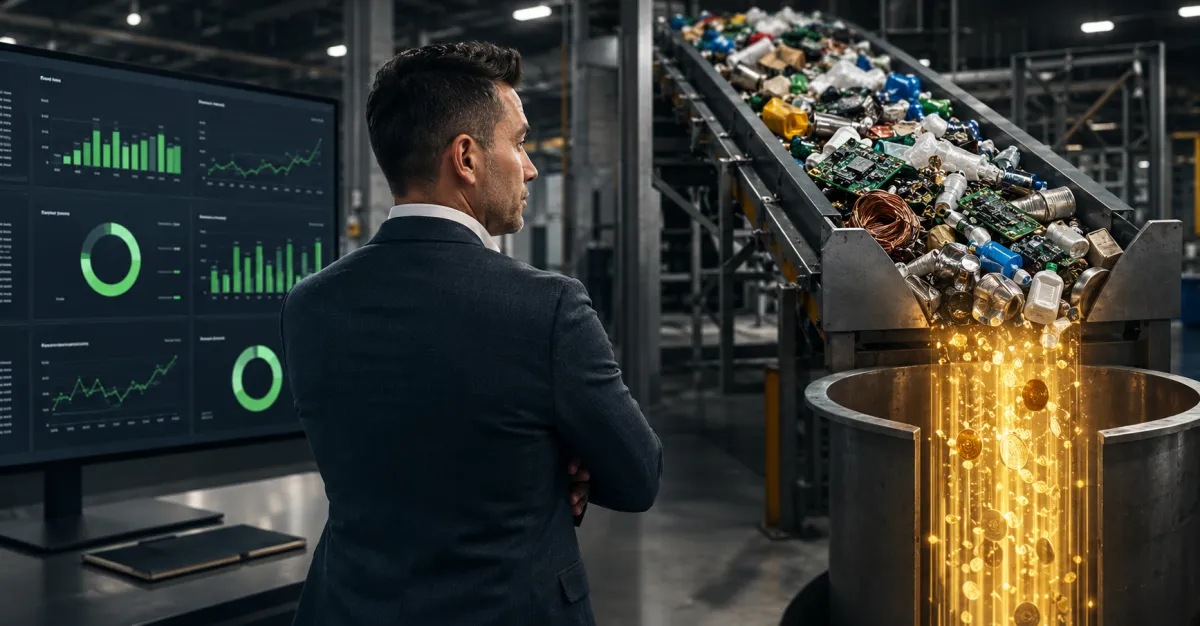
The Most Expensive Waste Stream in Your Company Is the One You Never Measure
Ask any owner of a waste company where their profit disappears, and you will get a confident answer.
Fuel. Labor. Insurance. Maintenance. Landfill fees. The customer who fights every price increase like it is a personal insult.
They can quote these numbers from memory. They have watched them climb for three years straight. They have squeezed routes, renegotiated with vendors, delayed a truck purchase, and had the uncomfortable conversation with the whole team about "tightening up."
And here is the uncomfortable truth I want to open with, because it is the whole point of this piece:
Almost every operator I have spoken with over the last several months can tell me exactly where their costs are.
Almost none of them can tell me where their value is going.
Those are not the same question. And the gap between them is where the real money lives.
You Probably Know Less About Your Profit Than You Think
Most owners believe they have a clear picture of their business economics. They have a P&L. They have an accountant. They have EBITDA they can recite in their sleep.
But a P&L tells you what already happened. It does not tell you what should have happened. It records the price you got. It says nothing about the price you could have gotten, and left on the table, and never saw.
That is the trap. The numbers on your financials feel like the full story because they are the only story anyone ever shows you. You cannot miss a cost — the invoice arrives, the bank account drops, the pain is immediate and visible. But you can miss value forever, because nothing on any report will ever flag revenue you didn't capture. There is no line item called "money we could have made and didn't."
So the operator optimizes what he can see. He becomes a genius at cost control. He runs a tight, disciplined, admirable operation.
And he slowly bleeds margin from a wound he has never once looked at.
I am not talking about waste. I am talking about the economics of the material moving through your yard every single day. The stream you touch, sort, bale, transfer, and sell — and largely stop thinking about the moment it leaves your gate.
That stream is the most expensive one in your company. Not because it costs you money to handle. Because of everything it could be worth, and isn't.
You Measure Everything Except the One Thing That Decides Your Margin
Walk into a well-run waste operation and look at what gets measured.
Truck utilization. Cost per stop. Tons per route. Fuel per mile. Overtime. Downtime. Landfill tipping cost. Contamination rates — but usually only because contamination triggers a fine or a rejected load, never because someone asked what contamination is costing in lost material grade.
Every one of those metrics points inward. Every one measures how efficiently you move material.
Now ask a different set of questions.
What is the actual downstream value of each stream you handle? Who are the end buyers — not your broker, the end user — and what are they willing to pay? How dependent are you on a single offtake partner who knows you have nowhere else to go? At what point in the chain does your material lose value, and how much? Are you selling a commodity when you could be selling a specified, prepared product?
For most operators, those questions produce silence. Not because they are bad operators. Because nobody ever taught them that these were questions a waste company was supposed to ask.
This is what I call the Unmeasured Waste Stream. Not a physical material. The economic layer sitting on top of your physical material — the value, the pricing power, the buyer relationships, the recovery decisions — that flows through your business completely unmonitored, while you meticulously track the diesel.
You would never run trucks without knowing your cost per mile. Yet most companies sell their entire output without knowing the real ceiling of what that output is worth. They measure the cheap side of the equation to the decimal and leave the expensive side blank.
How the Money Actually Leaks
Let me make this concrete, because "hidden value" is the kind of phrase that means nothing until you can see the mechanism.
Value doesn't vanish in one dramatic event. It escapes in small, structural, repeated decisions — decisions that feel normal because everyone in the sector makes them the same way.
Selling too early. A material moves out the door at the first grade, to the first buyer, at the first acceptable price. One more sorting pass, one contamination point removed, one grade of separation — and the same tonnage sells into a different market at a materially higher number. The operator never runs the comparison, so the upgrade never happens. The margin was there. It walked out on the truck.
Buyer concentration. I have sat with companies moving serious volume through a single downstream partner. That partner sets the price. Not the market — the partner. When one buyer controls your only exit, you are not a seller. You are a supplier being managed. The discount you are quietly paying for that dependency never appears anywhere in your accounting, but it is one of the most expensive things in your business.
The wrong downstream market entirely. Material gets sold into the channel the company has always used, because that is who they know. Meanwhile a different end-user — different specification, different geography, different application — would have paid more for the exact same output. The relationship simply never got built. Familiarity is comfortable. It is also, frequently, the most expensive habit on the yard.
Poor preparation and specification blindness. End buyers pay for material that meets a spec. Most operators have only a rough idea of what their best buyers actually need, so they prepare to a generic standard and sell at a generic price. The gap between "acceptable" and "exactly what the buyer specifies" is pure margin, and it is invisible until someone measures it.
Commodity dependence. When your revenue rises and falls entirely with an index you don't control, you have outsourced your profitability to a market that does not know you exist. Every operator feels the volatility. Very few have built the buyer intelligence that lets them ride it instead of being dragged by it.
Transfer station and secondary-processing economics. The material passing through your facility is often one modest step away from being worth substantially more. That step doesn't get taken — not because it isn't profitable, but because no one calculated whether it was.
None of these show up as a loss. Every one of them is a loss. Add them across a year and you are not talking about a rounding error. You are talking about the difference between a business that survives and a business that compounds.
The Next Generation of Waste Companies Will Not Look Like Yours
Here is where the sector is going, and it is worth sitting with, because it changes what "a good waste company" even means.
For decades, the winners in this industry competed on the things you could see from the road. Bigger fleet. Lower price. More volume. More routes. More trucks. It was a business of scale and logistics, and the biggest logistics operator usually won.
That game is quietly ending. Fuel, labor, and customer price resistance are compressing the margins on pure collection from both sides at once. You cannot cost-cut your way to a premium business. Everyone has the same trucks, the same routes, the same downward pressure, and the same customers who will not absorb another increase.
The companies that win the next decade will compete on something the road cannot see.
They will compete on market intelligence — knowing precisely what every stream is worth and where. On buyer networks — direct relationships with end users, not dependence on a single broker. On material intelligence — understanding their output at the level of specification, not just tonnage. On downstream economics and strategic partnerships that turn volatile commodities into contracted, defensible value.
They will not be the biggest. They will be the smartest about the economics of what they already handle. And they will quietly out-earn competitors twice their size — not because they collect more, but because they understand more.
Fleet size is a cost. Intelligence is a margin. The industry is about to sort itself into companies that understood that in time, and companies that didn't.
Every Waste Company Is Actually Two Businesses
This is the reframe I most want you to keep after you close this article.
Every waste company is really two businesses wearing one name.
Business Number One collects, hauls, and handles material. It runs the trucks. It services the accounts. It is operational, physical, visible, and hard. It is the business you built, the one you know intimately, the one you optimize every day.
Business Number Two manages the economics hidden inside that material — the pricing, the grading decisions, the buyer relationships, the recovery choices, the downstream positioning. It is commercial, invisible, and almost entirely unmanaged.
Here is the pattern I see everywhere, across every type of operator:
They pour everything into Business Number One. They invest in trucks, in processing equipment, in routes, in headcount, in efficiency. And they run Business Number Two on instinct, habit, and whatever the broker offers on a Tuesday.
They spend heavily to process material and almost nothing to monetize it. They will drop six figures on a piece of equipment to handle material better, and not one hour figuring out whether they are selling the output for what it is actually worth.
That is the whole game, and almost nobody is playing the second half of it.
The operators who have started to see this — the recyclers, the junk removal companies who realized their "junk" contained streams worth real money, the transfer stations, the MRF operators, the plastic processors, the sustainability leaders inside larger firms — they all arrive at the same sentence, usually with a slightly stunned look:
"We've been solving operational problems while ignoring economic ones."
Different businesses. Different sizes. Different materials. Same blind spot. Every time.
The Waste Stream Profit Diagnostic
Which brings me to why I built the Waste Stream Profit Diagnostic.
It is not consulting. It is not an audit. It is not an assessment with a binder at the end that sits on a shelf.
It exists to answer exactly one question:
Where is profit quietly leaking out of your business before anyone notices?
That's it. Not "how do we cut more costs" — you have that handled. The Diagnostic looks at the side of your business nobody is watching: the economics of your streams, your buyer dependency, your grading and preparation decisions, your downstream positioning. The Unmeasured Waste Stream. It finds the value that is escaping and puts a number on it.
But I will be direct with you, the way I would want someone to be direct with me.
Not every company qualifies, and not every company should. The Diagnostic is real work, and it only makes sense where there is enough hidden economic opportunity to justify it. For some operations, the honest answer is that the leak is small and the effort isn't worth it. I would rather tell you that early than sell you something you don't need.
So it doesn't start with the Diagnostic. It starts with a short Prequalification Conversation.
The entire purpose of that conversation is to determine one thing: whether enough hidden opportunity likely exists inside your operation to justify the full Diagnostic. No pressure. No hard sell. No manufactured urgency. Either there is a case worth pursuing, or there isn't, and you will know which within one honest exchange.
It is selective on purpose. The conversations that matter are the ones where something real is actually at stake.
The Invitation
Over the last few months I have discovered something that keeps repeating itself: the companies that uncover the biggest opportunities are almost never the ones with the biggest fleets. They are the ones willing to ask a better question about where their profit actually comes from.
That is why every Waste Stream Profit Diagnostic starts with a short qualification conversation.
Not because every company needs one. But because not every company has enough hidden opportunity to justify the work — and the only way to know is to look.
If you have read this far, some part of you is already wondering whether your operation is measuring the right things. That wondering is not a small thing. It is the exact instinct that separates the operators who compound from the operators who merely survive.
If you are curious whether the economics inside your streams are working for you or quietly working against you, I would be glad to find out together.
Book a Waste Stream Profit Diagnostic Prequalification Call. One conversation. One honest answer to the one question your financials will never ask on your behalf.
Because at this point, continuing to run a waste company without understanding the hidden economics of your own material isn't discipline.
It's an unnecessary risk — and it's the kind that never shows up on a report until it's far too big to ignore.
Sam Barrili
The Waste Alchemist
P.S. Over the past few months I've spoken with waste operators across North America — from junk removal companies to recyclers, transfer stations, MRFs and industrial processors. One thing has become very clear: the companies that benefited most from these conversations weren't necessarily the biggest. They were the ones willing to challenge the assumptions they had about where their profit really came from. If that describes how you think, we should talk.

As Seen In


Do You Struggle With This?
Would you like to generate more customers systematically but don't know how?
Do you want to optimize cost efficiency and improve your company's profitability?
Do you want to win customers' skepticism and avoid negative perceptions about your services?
Do you want to enhance your brand visibility to attract new and highly profiled clients?
Do you want to increase your company's turnover but don’t want to hire more people?
Do you want to stay ahead of your competitors, but you cannot fight the price battle?
Why People Work With Us
Waste Management Experience
More More than 15 years of direct expertise managing hazardous waste all around the world.
Global Expertise
Our strategies are successful in the collection of recyclables, MSW, and hazardous waste.
A Tailored Service
Our direct-response marketing is tailored to help Small Waste Companies and Junk Removals.
M4W - Marketing For Waste is a brand of MiM LLC - 16192 Coastal Highway - 19958 Lewes - DE - USA
[email protected]