We Create Marketing Strategies
For Small Waste Management Companies
And Junk Removals
Why Your Biggest Revenue Problem Has Nothing to Do with Revenue
The case for looking inside your operation before you look for more volume
The Phrase That Runs Your Business Without Your Permission
There is a sentence spoken inside waste operations every single day, thousands of times, across every market segment and every country. It comes from experienced operators, not rookies. It is delivered with confidence, not hesitation. And it costs more than most operators will ever be able to calculate, because the damage it does is invisible by design.
The sentence is this: "That's about right."
It shows up when someone asks what you're getting per ton for mixed plastics. It shows up when a driver quotes a collection price on the spot. It shows up in a meeting when someone asks what margin you're running on the municipal contract. It shows up in the purchasing discussion when a buyer offers you a price for a load and you have no benchmark to push back with. It shows up every single time someone in your operation is asked a question they don't have real data to answer — and decides that an estimate dressed up as certainty is close enough.
It isn't close enough. It never was.
I have spent more than fifteen years working inside waste operations across Europe, North America, and Africa. I have sat in the offices of haulers, recyclers, transfer station operators, metal dealers, e-waste processors, C&D recyclers, and landfill operators. I have reviewed their pricing structures, their commodity contracts, their customer profitability numbers, and their stream-by-stream margins. And I will tell you with complete confidence that the single most consistent source of profit loss I find in these businesses is not a cost problem. It is not a labor shortage. It is not fuel volatility or commodity market unpredictability.
It is the quiet, unchallenged assumption embedded in those three words.
This article is about what that assumption actually costs you — and what the operators who have stopped using it are doing differently.
The Tonnage Illusion: Why Volume Is Not the Same as Value
The waste industry measures itself in tons. Tons hauled. Tons processed. Tons diverted. Tons landfilled. It is the native unit of the sector, and for good reason — volume matters operationally. You cannot run a profitable collection business without understanding your capacity utilization. You cannot run a processing facility without understanding throughput. Volume is a real metric.
The problem is that for too many operators, it has become the only metric. And when volume becomes the primary lens through which a business evaluates itself, a deeply dangerous equivalence takes hold: the assumption that more tonnage means more money. That the path to a better business is always more trucks, more contracts, more volume.
Consider two independent waste operators. Both are processing approximately 50,000 tons per year of mixed commercial and industrial waste. Both are in similar markets with comparable labor and fuel costs. Both have been in business for more than a decade. By the most common measure in the industry, they are running equivalent operations.
One of them is generating strong, consistent margin and building equity in his business. The other is running thin, watching cash flow tighten, and carrying more operational stress than his revenue justifies. He has considered buying another truck to grow his way out of the problem. His accountant has suggested cutting costs. Neither suggestion gets at the actual issue.
The difference between these two operators is not volume. It is not efficiency in the conventional sense. It is what happens to material after it enters the facility — specifically, who understands the value of what they are processing, and who has simply decided that the prices they are getting are "about right."
The first operator has, over time, built a working knowledge of which material streams inside his operation generate margin and which ones cost him money. He has made decisions — about sorting investment, about which customers he accepts waste from, about how he negotiates downstream contracts — based on actual stream-level data. The second operator has never had that conversation with himself. He knows his total revenue. He knows his total cost. The gap looks like profit. He has never asked whether the mix of streams he is processing is the optimal mix, or whether the prices he is receiving reflect the actual recoverable value inside those loads.
This is the tonnage illusion: the belief that a business running at volume is a business running well. It conflates activity with profitability, throughput with value, and busyness with business intelligence.
Where the Hidden Profit Actually Lives
The phrase "hidden profit" tends to make operators skeptical. It sounds like consulting language, a premise designed to make a sale. I understand that skepticism. So let me be specific, because the profit I am describing is not theoretical and it is not small.
Mixed Materials: The Single Largest Recoverable Opportunity
When a waste operator accepts a load of mixed plastics from a commercial generator and sells it as mixed plastics, he is selling the average. What he is almost certainly holding inside that load is a distribution of individual fractions with dramatically different downstream values. Clean HDPE can be worth two to three times more per ton than a mixed plastics bale, depending on current commodity markets. Clean PP, clean PET, clean LDPE — each has its own market, its own buyer network, its own pricing dynamics.
The reason most operators sell mixed rather than separated is straightforward: separation costs money and takes time. The equipment investment can be significant. The labor requirements are real. But the question operators rarely ask with full financial rigor is this: what is the actual per-ton revenue difference between selling mixed and selling separated, and does that gap justify the separation cost at our current volume? Many operators who have run that calculation honestly have discovered that the answer is yes — and that they have been leaving a recoverable margin gap unclosed for years, not because separation was impossible, but because nobody ever sat down and did the arithmetic.
The same logic applies to mixed metals. Ferrous and non-ferrous fractions sell at very different price points. Mixed non-ferrous bales containing copper, aluminum, and stainless steel in varying proportions are priced conservatively by buyers precisely because the buyer is accepting the uncertainty of the mix. When the operator has no data on the composition of what he is selling, he is in no position to negotiate. The buyer who does know the composition — because he has handled enough of this material to estimate it accurately — benefits from that information asymmetry every single time.
In the e-waste sector, this dynamic is even more acute. The value distribution inside a mixed electronics load is dramatic. A load that contains meaningful quantities of circuit boards, high-grade components, and precious metal-bearing materials is worth significantly more than a load of predominantly plastic chassis and display panels. Mixed e-waste pricing reflects that uncertainty downward. Operators who understand how to characterize and sort their incoming streams before negotiating disposal or recovery contracts consistently recover more value from identical tonnage.
The High-Volume Customer Who Is Quietly Destroying Your Margin
Every waste company has at least one of them. A large commercial or industrial account that drives significant tonnage. The relationship is long-standing. The customer is not difficult. The volume feels good. The account feels profitable because it is large.
The problem is that "large" and "profitable" are not synonyms, and in the waste business specifically, they are often inversely correlated. Large commercial generators typically produce lower-quality material — higher contamination, more mixed streams, less predictable composition — than smaller specialized generators. They often negotiate harder on collection fees because their volume gives them leverage. They are frequently more demanding operationally, requiring more frequent pickups, more specialized handling, or customized service arrangements that add cost without adding proportional revenue.
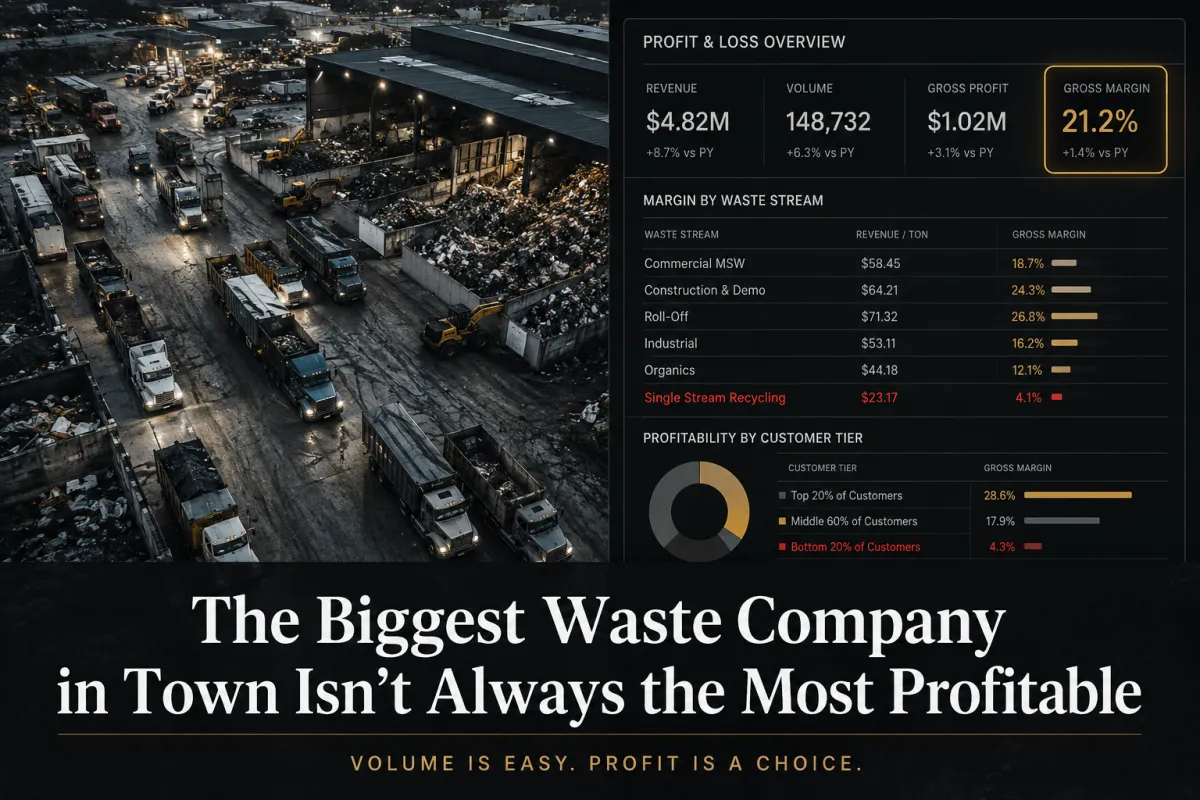
I have reviewed customer profitability analyses for operators who discovered that their largest account by volume was generating less than half the margin per ton of their median account. In several cases, the large account was running at a loss when fully loaded costs — collection, processing, downstream disposal or sale, account management time — were allocated properly. The operators had never run that analysis. They had assumed, based on the size of the revenue number, that the account was a cornerstone of their business. It was, in fact, a cash flow generator that was quietly subsidized by more profitable accounts they had given less attention to precisely because they were smaller.
This is not a rare finding. It is the norm in operations that have not built stream-level and account-level profitability tracking. And the cost of not knowing is not just the margin you are losing on a bad account. It is the opportunity cost of the attention, capacity, and capital you are directing toward a low-margin relationship instead of redeploying toward better ones.
Treating Waste as Disposal Instead of Inventory
There is a foundational mental model that dominates the waste industry and that I believe is the source of more margin destruction than any other single factor. It is the disposal mindset: the belief that waste is something to be moved, processed, and eliminated as efficiently as possible, with the goal of minimizing cost and maximizing throughput speed.
The disposal mindset produces a very specific set of operational behaviors. It prices services primarily by collection cost and compliance requirement. It treats outgoing material as a cost to be minimized rather than an asset to be maximized. It optimizes for volume and speed rather than for material quality and downstream value. It does not invest in characterization, sorting, or market development because those activities do not appear to affect the core metric of tons moved per dollar spent.
The inventory mindset — the one used by the most profitable operators I know — treats incoming waste as raw material. It asks not "what does it cost me to move this?" but "what is this actually worth and how do I recover as much of that value as possible?" It segments incoming streams by downstream value before deciding how to process them. It tracks output quality because quality determines price. It develops relationships with downstream buyers not just transactionally but strategically, understanding market timing and buyer incentives well enough to negotiate effectively.
The practical difference between these two mental models shows up in the financials. Operators running the inventory mindset against identical tonnage as their disposal-minded competitors routinely generate better margins, not because they are more efficient, but because they are extracting more value from what they already control.
The Underpricing Problem: When "Competitive" Becomes Unprofitable
Pricing in the waste industry is often set by feel, by competitive comparison, or by historical inertia. A service fee established five years ago gets adjusted annually for fuel cost changes and left otherwise intact. A tipping fee gets set by looking at what nearby facilities charge and matching it, possibly with a small discount to capture volume. A processing fee gets negotiated based on what the customer says competitors are offering, without independent verification.
None of this pricing logic is built on a calculation of what the service actually costs to deliver, stream by stream, and what margin is required to make it worth providing. The result is that many waste operators are systematically underpricing certain services — specifically services on high-value incoming streams where they could charge more precisely because the generator's alternative is worse — while pricing other services correctly or even aggressively.
The underpricing problem is compounded by the absence of stream-level cost accounting. If you do not know what it costs you to collect, process, sort, and recover or dispose of each distinct material type, you cannot know whether the price you are charging for handling that material is generating a margin or destroying one. You are setting prices against an average that obscures the distribution, and the distribution is what matters.
Commodity Market Timing: The Profit Opportunity Most Operators Leave on the Table
Commodity markets for secondary materials — metals, plastics, paper fiber, e-waste fractions — are not static. They move, sometimes dramatically, in response to export demand, manufacturing cycles, regulatory changes, and macro-economic conditions. Operators who understand this and manage their inventory and contract timing accordingly generate meaningfully better realized prices than operators who sell consistently regardless of market conditions.
This is not a sophisticated trading strategy. It is operational discipline. It requires knowing what you have in inventory, understanding the current market well enough to have a view on direction, and having enough financial flexibility to hold material for a reasonable window when market conditions are unfavorable. Very few small and mid-sized operators do this systematically. Most sell when they have volume to move, which means they are often selling at the worst possible time from a market standpoint — when processors and buyers are also flush with material and have the most pricing leverage.
The operators who have built even a basic version of this capability — a working market awareness, a relationship with multiple downstream buyers, a policy of timing significant sales against market signals — consistently report realizing better per-ton prices than their peers processing the same material.
The Measurement Problem: You Cannot Optimize What You Have Not Measured
All of the profit leaks described above have a common root cause. They persist not because operators are incompetent or indifferent, but because the information required to identify and close them does not exist in most waste operations. The management information available to most operators consists of total revenue, total cost, and the gap between them. It tells you whether the business is making money. It does not tell you where the money is being made and lost, which streams are profitable and which are not, which customers are worth having and which are costing you, or whether the prices you are receiving reflect the value you are delivering.
Building stream-level profitability visibility is not a technology problem. It does not require a sophisticated software implementation or a major capital investment. It requires a decision to track the right inputs — incoming stream composition, processing cost by stream, output quality and volume by stream, realized selling price by output fraction, and time and labor allocation by activity — and a commitment to review those numbers with the same attention currently reserved for total revenue and total fleet utilization.
Operators who make that commitment almost universally find the same thing: the distribution of profitability across their business is not what they assumed. Some streams they thought were commodities turn out to be significant margin contributors when properly separated and marketed. Some accounts they considered core to their business turn out to be performing well below the company average. Some services they have been pricing by convention turn out to be significantly underpriced relative to the value they deliver and the alternatives available to the generator.
The finding is not always comfortable. But it is always actionable.
What the Most Profitable Operators in This Industry Do Differently
The operators generating the strongest margins in the $2M–$30M revenue range share a set of behaviors that are not complicated, not capital-intensive, and not dependent on market conditions outside their control. They are disciplined in how they think about what enters their facility. They track profitability by stream, not just by total business. They make account retention decisions based on actual profitability data, not on the emotional weight of a long-standing relationship or the visual impression of a large revenue number. They understand their downstream markets well enough to negotiate with real information rather than accepting the first offer they receive. They have made at least a basic investment in improving material quality at the output stage, because they understand that quality determines price.
None of these behaviors are exotic. They are the equivalent in the waste industry of what any well-run manufacturing company does with raw material management, yield tracking, and sales pricing discipline. The waste sector has been slow to adopt this kind of operational intelligence not because it is unavailable, but because the mental model of the industry — the disposal mindset — has not required it. You can run a waste business without it. You just cannot run it optimally.
The gap between running and running optimally, in my experience across hundreds of operations, is typically somewhere between twenty and forty percent of the profit a business could be generating from its existing asset base. That is not a marginal improvement. At a company generating $5M in revenue, closing half that gap represents a significant and durable change in financial performance — achieved not by growing the top line but by extracting more value from the volume already being processed.
Conclusion: The Profit Is Already There. The Question Is Whether You Can See It.
The waste companies that will define this industry over the next decade are not the ones that figure out how to move more tons. The commodity price environment, the regulatory landscape, and the increasing sophistication of downstream markets are all creating conditions where the intelligent management of material value will generate more durable competitive advantage than any amount of fleet expansion or volume growth.
The operators who build that capability — who stop running their businesses on the assumption that the prices and margins they are receiving are "about right" and start demanding actual data — will find that there was more profit inside their existing operation than they realized. Not because they were failing. But because they were running on assumptions in a business that rewards precision.
The next time someone in your operation is asked a question about pricing, margins, or commodity value and you hear those three words — "that's about right" — treat it as a signal. Not a crisis, but a flag. An indication that somewhere in the business, a real number has been replaced by an estimate, and that estimate may be costing you more than you think.
The profitable operators have stopped accepting that answer. You can too.
Want to Know Where the Hidden Profit Is in Your Operation?
I've put together a Hidden Profit Report that maps the most common profit leaks in waste operations and the specific questions operators need to ask to find and close them. If you want it, mail me REPORT at [email protected] and I'll send it directly.
If you'd rather skip the report and go straight to mapping your own operation stream by stream, comment AUDIT below. My Waste Stream Profit Audit is a focused 90-minute session where we work through your specific streams, pricing, and customer mix — and identify where the real margin opportunity is sitting.
No pitch. No automated funnel. A direct response from me.
To Your Success
Sam Barrili
The Waste Management Alchemist

As Seen In



Do You Struggle With This?
Would you like to generate more customers systematically but don't know how?
Do you want to optimize cost efficiency and improve your company's profitability?
Do you want to win customers' skepticism and avoid negative perceptions about your services?
Do you want to enhance your brand visibility to attract new and highly profiled clients?
Do you want to increase your company's turnover but don’t want to hire more people?
Do you want to stay ahead of your competitors, but you cannot fight the price battle?
Why People Work With Us
Waste Management Experience
More More than 15 years of direct expertise managing hazardous waste all around the world.
Global Expertise
Our strategies are successful in the collection of recyclables, MSW, and hazardous waste.
A Tailored Service
Our direct-response marketing is tailored to help Small Waste Companies and Junk Removals.
M4W - Marketing For Waste is a brand of MiM LLC - 16192 Coastal Highway - 19958 Lewes - DE - USA
[email protected]