We Create Marketing Strategies
For Small Waste Management Companies
And Junk Removals
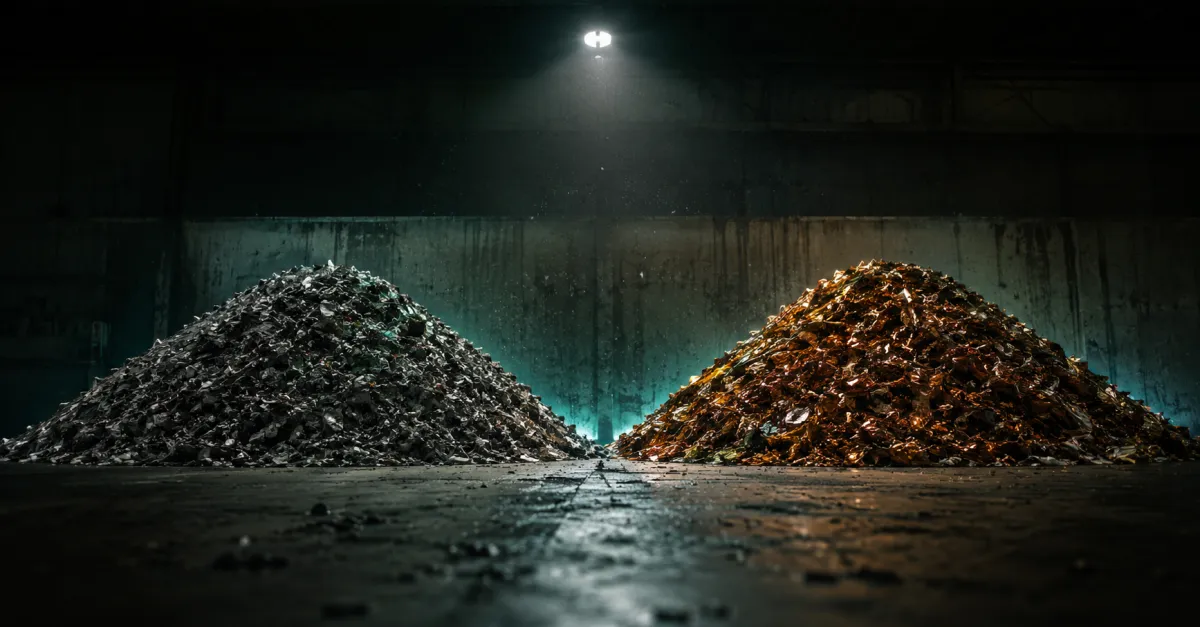
Why Two Waste Companies Collecting the Same Material Can Have Completely Different Profits
Let me give you the objection before you raise it.
Route density matters. Haul distance matters. A hauler with forty stops per mile is not running the same business as a hauler covering three counties for the same tonnage. Anyone who tells you geography is irrelevant has never sat in the cab at 5 a.m. watching diesel burn while the truck waits for a gate to open.
So let's agree on that and move past it.
Because here's what I've been finding across North America, in operation after operation, over the last several months of conversations:
Operations set your floor. They don't set your ceiling.
And when I look at two companies with the same density, the same fuel bill, the same labor market, the same landfill tipping fee, the same material coming across the same scale — I still find profit gaps wide enough to drive a roll-off through.
That gap has nothing to do with the waste.
That gap is the whole article.
The Assumption That's Quietly Costing You
Most owners in this industry believe they're competing on execution.
Better routes. Better drivers. Better equipment. Better uptime. Tighter maintenance intervals. Fewer callbacks.
All of that is true. All of that is necessary. And all of that is now table stakes.
Here's the uncomfortable part: execution excellence is convergent. Everyone eventually gets there. Your competitor buys the same telematics. Hires from the same driver pool. Negotiates the same fuel card. Runs the same maintenance software. The operational gap between a good company and a great company in this industry has been closing for fifteen years.
Which means if you're still competing there — you're competing in a shrinking room.
Meanwhile, the profit gap between operators is widening.
Both things can't be true unless the profit is coming from somewhere else.
Ask yourself: In the last twelve months, how many of your strategic decisions were about moving material more efficiently — and how many were about what happens to that material after it leaves your yard?
Company A and Company B
Two junk removal operations. Same metro. Same trucks. Same crew size. Same Google Ads spend. Same average job ticket.
Company A ends the year at a respectable margin. Company B ends the year at nearly double.
Same material. Same city. Same jobs.
Two recyclers. Same intake volume of mixed rigid plastics. Same sorting line, same vintage, same throughput.
Company A sells to one broker. Company B sells to four buyers across three end-use applications, one of which didn't exist as a market eighteen months ago.
Same material. Same equipment. Wildly different revenue per ton.
Two transfer stations. Same permitted tonnage. Same catchment area. Same regulatory regime.
Company A is a pass-through: material in, material out, margin on the spread. Company B treats the floor as an intelligence gathering operation and has restructured its inbound pricing three times in two years based on what it learned.
Same station. Same permit. Different business.
So — why?
Not one of these pairs is separated by their equipment. Not one is separated by their people. Not one is separated by their material.
The Two Businesses You're Actually Running
Every waste company in the world operates two businesses simultaneously. Most owners only know about one.
Business #1: Moving waste. Trucks. Routes. Labor. Fuel. Containers. Compliance. Uptime. This business is a logistics business. Its economics are the economics of every logistics business ever built: volume, density, utilization, cost per unit moved.
Business #2: Extracting economic value from waste. Material specification. Buyer relationships. End-market intelligence. Purity thresholds. Alternative applications. Downstream positioning. Contract structure. Price discovery.
This business is a trading and intelligence business. Its economics have nothing in common with logistics.
Here is what happens in practice: Business #1 is loud and Business #2 is silent.
Business #1 sends you a fuel invoice every week. It calls you when a truck breaks. It shows up in your P&L as a screaming line item. It demands attention because it makes noise.
Business #2 never calls. It never sends an invoice. It doesn't break down. When you leave forty dollars a ton on the table because you sold a specification you never verified to a buyer you never benchmarked — nothing happens. No alarm goes off. No one tells you.
You just make less money forever, quietly, and call it market conditions.
The most profitable operators I've encountered aren't better at Business #1. Many are merely adequate at it.
They are masters of Business #2.
Ask yourself: Who in your organization owns Business #2? Not "who sells the material" — who owns the intelligence? If the answer is "nobody, really" or "well, that's kind of me, when I have time" — you've found it.
The Measurement Trap
Look at what Company A measures.
Fuel per route. Driver hours. Maintenance cost per unit. Landfill tipping fees. Container utilization. Pull rates. Days sales outstanding.
Every single one of those is a cost of moving.
Now look at what Company B measures.
Buyer performance versus benchmark. Material purity against spec, by stream, by inbound source. Secondary market demand curves. Which of their materials are reaching their highest-value application and which are being sold down the food chain. Buyer concentration risk. Specification premiums they're eligible for but not capturing. Forward market signal on the streams they touch.
Every single one of those is a determinant of value.
Here's the trap, and it's brutal in its elegance:
Company A's KPIs are perfect. They're measuring the right things beautifully. And they are structurally incapable of revealing where the money is.
You cannot find profit leakage in a downstream market by measuring fuel consumption. The instrument doesn't detect the phenomenon. It's like trying to find a gas leak with a thermometer — the tool works, it's just answering a different question.
This is why so many operators are convinced they've optimized everything. They have optimized everything they measure. That's precisely the problem.
The traditional KPI dashboard in this industry is a beautifully engineered blindfold.
Ask yourself: How many buyers do you actually have for your top five material streams? Not could have. Have. Right now. Buyers who have taken material from you in the last ninety days.
And the follow-up, which is the one that should keep you up: if your largest downstream buyer disappeared tomorrow, what happens to your margin? Not your volume — your margin.
If you don't know the answer within five percentage points, you are running a business whose profitability is controlled by someone whose name isn't on your building.
What the Next Generation Actually Looks Like
The waste company that wins the next decade doesn't look like a better version of the waste company that won the last one.
It looks like this:
It sells specifications, not tonnage. It knows that "mixed rigids" and "verified spec, sub-2% contamination, consistent color band, delivered to a documented standard" are different products at different prices, made from identical material. One is a commodity. The other is an input someone's production line depends on. Commodities compete on price. Inputs compete on reliability — and reliability commands premium.
It treats buyers as a portfolio, not a relationship. One buyer isn't a relationship. It's a dependency wearing a relationship's clothes. Four buyers across three applications is a portfolio, and portfolios have pricing power.
It has visibility past its own gate. It knows what happens to its material two steps downstream — because the second step is where the value gets created, and if you can't see it, you can't price yourself into it.
It builds partnerships that change the material, not just move it. The highest-margin operators I've seen didn't buy new equipment. They found a partner whose process turned their low-value output into someone else's high-value input, and they restructured the deal to capture part of that lift.
It understands that regulation is a market event. Every compliance shift is a repricing event for someone. The operators who read it as a burden absorb the cost. The operators who read it as a signal capture the margin.
None of this requires new trucks.
All of it requires knowing things your competitor doesn't.
Ask yourself: When was the last time you verified — not assumed, verified — that your materials were reaching their highest-value application?
If the honest answer is "we've always sold it to Frank," then Frank is the one running Business #2. He's just running it on his balance sheet instead of yours.
The Question Underneath All of This
Strip everything above away and one question remains:
How does your business compare economically with what is actually possible with the exact material you already collect?
Not what's possible in theory. Not what's possible for a company ten times your size. What's possible for your streams, your volumes, your geography, your buyers.
That's not a philosophical question. It has a number attached to it. And most operators have never calculated it — not because they're careless, but because their measurement system was never designed to produce it.
That number is what the Waste Stream Profit Diagnostic exists to find.
It isn't consulting. It isn't an audit. It isn't an assessment. Nobody arrives with a clipboard to tell you your routes are inefficient — you already know your routes better than I ever will.
It's a structured way to answer that one question. Where the gap is between what your material earns and what your material is capable of earning.
And here's the part that matters: not every company qualifies.
Some operations genuinely don't have enough hidden opportunity to justify the work. If your streams are thin, your volumes are marginal, or you've already built the buyer intelligence — the Diagnostic will find a rounding error and waste both our time. I'd rather tell you that in twenty minutes than three weeks.
Which is why the process always begins with a short Prequalification Conversation. Its only purpose is to determine whether enough hidden opportunity exists to justify the full Diagnostic.
The Only Thing Left to Decide
If another company collecting exactly the same material as you could generate significantly more value from it, wouldn't you want to know why?
Not eventually. Not next budget cycle. Now — while the gap is still something you can close rather than something that's already decided your market position for you.
That's what the Prequalification Conversation is for.
Not every company qualifies.
But if yours does, the conversation could permanently change how you look at what's crossing your scale every single day.
Book the Prequalification Call →
Sam Barrili
"The Waste Management Alchemist"
International Waste Management Strategist
This is Part 4 of an ongoing series. Part 1: Your Waste Company Doesn't Have a Waste Problem. It Has a Market Problem. Part 2: Recycling Isn't Broken. The Economics Around It Are. Part 3: The Most Expensive Waste Stream in Your Company Is the One You Never Measure.

As Seen In


Do You Struggle With This?
Would you like to generate more customers systematically but don't know how?
Do you want to optimize cost efficiency and improve your company's profitability?
Do you want to win customers' skepticism and avoid negative perceptions about your services?
Do you want to enhance your brand visibility to attract new and highly profiled clients?
Do you want to increase your company's turnover but don’t want to hire more people?
Do you want to stay ahead of your competitors, but you cannot fight the price battle?
Why People Work With Us
Waste Management Experience
More More than 15 years of direct expertise managing hazardous waste all around the world.
Global Expertise
Our strategies are successful in the collection of recyclables, MSW, and hazardous waste.
A Tailored Service
Our direct-response marketing is tailored to help Small Waste Companies and Junk Removals.
M4W - Marketing For Waste is a brand of MiM LLC - 16192 Coastal Highway - 19958 Lewes - DE - USA
[email protected]