
We Create Marketing Strategies
For Small Waste Management Companies
And Junk Removals

The Per-Ton Ceiling: Why is your margin capped by physics, not by your competitor
There is a number in your business you have probably never calculated.
Not revenue. Not tons per month. Not cost per stop.
The number is this: the maximum margin your business model can produce, per ton, before you change what the business actually does.
Most operators assume that number is set by the market — by what the guy across town charges, by the landfill's tipping fee, by diesel. It isn't. It's set by the structure of the model itself. And once you see where the ceiling sits, you stop trying to out-hustle it and start trying to leave.
The arithmetic nobody puts on paper
Take a roll-off pull. Illustrative figures — substitute your own:
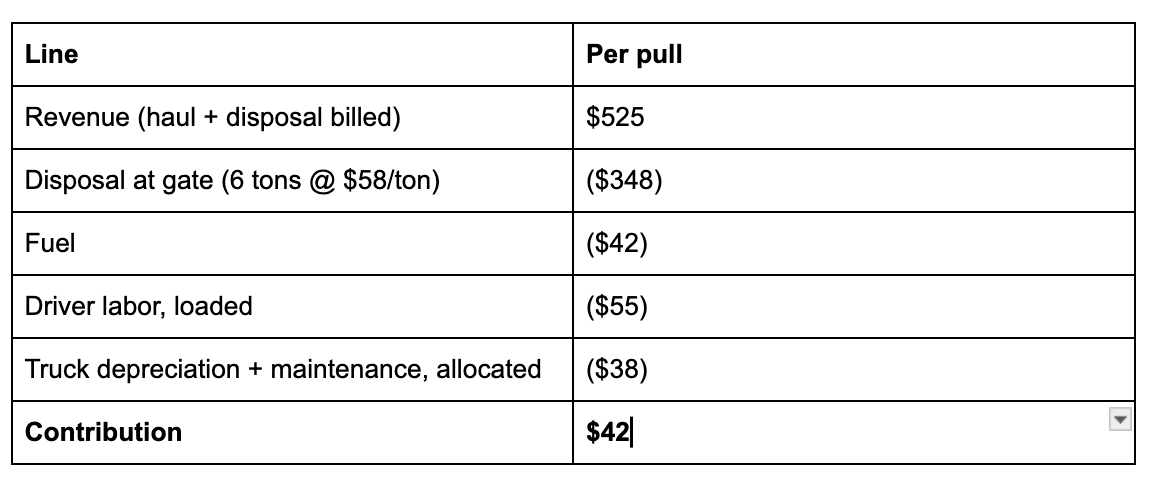
Eight percent. On a good day, with a full box and no dry run.
Now run the sensitivity. Tipping fee rises $6 a ton — a routine annual move in most US markets. Contribution goes to $6. One dry run in twenty wipes out the month. That's not a business with thin margins. That's a business operating inside a corridor two variables wide, where both variables are controlled by someone else.
The landfill sets your largest cost. The refinery sets your fuel. You set neither.
Why growth doesn't fix it
The instinctive answer is volume. More pulls, more routes, more trucks.
But look at what scales. Revenue scales linearly with tons. So does disposal cost. So does fuel. So does labor. So does the capex required to move those tons. You are not building operating leverage — you are replicating a fixed spread, over and over, and paying for the privilege each time with a truck.
Doubling the fleet doubles the contribution and doubles the exposure. The percentage never moves. This is why operators who grow from $4M to $12M so often find themselves with more stress, more debt, and the same bank balance. They didn't fix the model. They scaled it.
The ceiling isn't a market condition. It's arithmetic.
The physical constraint underneath
Here is where it gets structural, and where most consultants stop because they don't know the material.
You are paid by weight. You are constrained by volume.
Every truck has a legal weight limit and a physical box volume. For dense streams — C&D, aggregates, wet organics — you hit the weight limit with the box half empty. For light streams — film plastics, EPS, mixed commercial — you hit the volume limit at a fraction of the payload you're licensed to carry. Either way, you are paying to move air or paying to move an underloaded box.
The industry's answer has always been compaction. And compaction works, up to a point — that's the important part. Density gain per unit of energy input is not linear. The first pass is cheap. The second costs more for less. Beyond a certain density, you are spending significant energy, mechanical wear, and cycle time to gain marginal payload, and eventually the compaction itself degrades the material's recoverability — you contaminate, you embed, you cross-contaminate fractions that were separable when they were loose.
There is an asymptote. You can approach it. You cannot pass it. And every operator in the sector is already operating close enough to it that the remaining gain is not where your margin is hiding.
This is the same principle I've argued about circularity itself: physical systems have limits that no amount of operational excellence negotiates away. The compaction curve is that limit, expressed in a truck.
So if volume won't fix it and density won't fix it, only one variable is left.
The variable you're not being paid on
Two trucks leave your yard. Identical vehicle, identical route, identical tonnage.
Truck A carries mixed construction debris. Truck B carries source-separated WEEE with recoverable copper, gold-bearing boards, and aluminium housings.
Same invoice.
Read that again, because it is the whole argument. Your pricing model is blind to the composition of what you are carrying. You have built an entire enterprise around the transport of mass, and mass is the one property of your material that carries no commercial information whatsoever.
The value of what's in the box is not in your revenue line. It is in someone else's.
That is not a pricing error you can correct with a rate increase. It is the definition of a hauling business. And it is why the ceiling exists — you are selling a service whose price is bounded by your customer's next-cheapest alternative, while carrying an asset whose price is set by an entirely different market you have no position in.
What this series is going to do about it
Over the next three pieces I'm going to take this apart in order.
The next one prices the handoff — exactly where your margin goes when the material leaves your gate, stream by stream, with the spreads attached. Wood, organics, WEEE, plastics, digestate. You will see the number you're leaving in someone else's P&L.
The third shows how to capture a meaningful share of that spread on a single stream without becoming a processor, without capex, and without a permit. This is the piece most of you can execute inside ninety days.
The fourth answers the question the first three raise and don't settle: there is a threshold — a specific monthly volume, a specific contract duration, a specific level of secured offtake — above which building your own processing capability pays, and below which it destroys operators. That number has killed more good waste companies than any competitor ever has.
I'll give you the threshold in the fourth article. Not before. Because if you act on it without the first three, you will build the wrong thing.
The Operator's Takeaway
Run the per-pull arithmetic above on your own three largest accounts this week. Not on the average — on the specific accounts. If contribution per pull is under 10%, your problem is not your route density, your dispatcher, or the operator across town. It's that your revenue model cannot see the material you're carrying.
To Your Success
Sam
Sam Barrili is an international waste management strategist and the author of The Waste Alchemy. He works with waste operators across the United States and Europe on stream identification, control, and monetization.

As Seen In




Do You Struggle With This?
Would you like to generate more customers systematically but don't know how?
Do you want to optimize cost efficiency and improve your company's profitability?
Do you want to win customers' skepticism and avoid negative perceptions about your services?
Do you want to enhance your brand visibility to attract new and highly profiled clients?
Do you want to increase your company's turnover but don’t want to hire more people?
Do you want to stay ahead of your competitors, but you cannot fight the price battle?
Why People Work With Us
Waste Management Experience
More More than 15 years of direct expertise managing hazardous waste all around the world.
Global Expertise
Our strategies are successful in the collection of recyclables, MSW, and hazardous waste.
A Tailored Service
Our direct-response marketing is tailored to help Small Waste Companies and Junk Removals.
M4W - Marketing For Waste is a brand of MiM LLC - 16192 Coastal Highway - 19958 Lewes - DE - USA
[email protected]